If you’ve spent any time looking for activity-book ideas for Amazon KDP or Etsy, you’ve probably noticed the same problem: many categories feel crowded.
Our Review Rating: ⭐⭐⭐⭐⭐ 4.9/5

Word searches are everywhere. Sudoku books are everywhere. Basic mazes, crosswords, journals and generic kids’ activity books have thousands of competing listings.
You can change the cover, target a different age group and find a new keyword, but sometimes the actual product still feels very similar to what hundreds of other sellers are already creating.
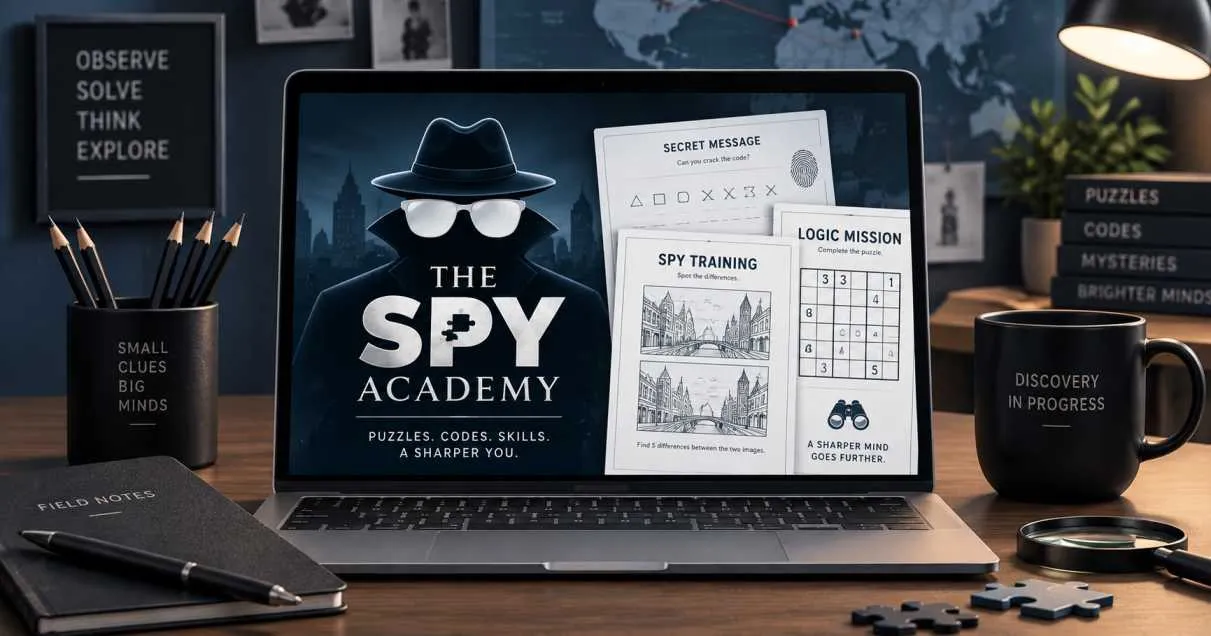
That’s what made The Spy Academy Powered by Activity Book Generator interesting to me.
Instead of helping publishers make another standard word-search or Sudoku book, it focuses on something much more specific: spy, mystery and detective-themed puzzle books.
Think secret messages, ciphers, code-breaking missions and puzzle-based spy stories.
But having an interesting concept doesn’t automatically make a tool worth buying. So in this The Spy Academy review, I’ll look at what the software actually does, who it makes sense for, where it can save time, and what you should know before purchasing.
The Spy Academy Specification Table
| Specification | Details |
|---|---|
| Product Name | The Spy Academy |
| Product Form | Online Activity Book & Spy Puzzle Generator Software |
| Category | AI Publishing & Activity Book Creation Software |
| Best For | Supports KDP, Etsy, and digital-product creators who want to create spy, mystery, detective, and code-breaking activity books |
| Price | $37 One-Time Payment |
| Refund Policy | Refund terms are not clearly stated on the current sales page; buyers should verify the latest policy on the official checkout page before purchasing |
| Availability | Online through the official website |
| Official Website | Visit Official Website |
| Overall Ratings | Our Review Rating: ⭐⭐⭐⭐⭐ 4.9/5 |
Table of Contents
Table of Contents
What Is The Spy Academy?
The Spy Academy is a browser-based activity-book creation platform built around the spy, mystery and detective niche.
According to the current product page, it includes five dedicated puzzle generators:
Cipher Crackers, Anagram Missions, Code Breaker Challenges, Secret Message Decoders and Code Word Puzzles.
There is also a Spy Mission Books Builder designed to create full narrative-style spy stories with puzzles and code-breaking activities woven into the story.
The basic idea is straightforward.
Instead of manually designing individual puzzles, formatting answer pages and assembling everything yourself, you choose the activity style and audience, customize the settings, generate the material and download a finished PDF.
That makes it especially interesting for people creating products for Amazon KDP, Etsy, Teachers Pay Teachers or their own printable shops.
The Problem The Spy Academy Is Trying to Solve
Creating an activity book sounds simple until you actually start doing it.
You need an idea.
Then you need puzzles.
Then you need correct answers.
Then those puzzles need to be formatted consistently.
Then the pages have to fit the size of the book you’re publishing.
And after all that work, you still need a product concept that doesn’t look exactly like everything else already available.
This is where a niche-specific tool can make sense.
The Spy Academy isn’t trying to create every type of activity book. Its strength is that it focuses on one recognizable theme and gives publishers multiple puzzle formats that fit naturally inside that theme.
Instead of making a generic puzzle book and adding a spy image to the cover, you can build the spy theme into the activities themselves.
That’s an important difference.
How Does The Spy Academy Work?
The workflow is designed to be relatively simple.
You select the type of puzzle you want to create, choose the intended audience and difficulty, customize formatting options, and generate your pages.
The sales page currently lists 16 page sizes, different font-size settings, color or black-and-white output and automatically generated answer keys. The five core activity generators are advertised with unlimited PDF generation.
Once you’re happy with the output, you download the PDF and continue with your normal publishing process.
That means you don’t necessarily have to start every cipher, decoder or code challenge from scratch.
For a publisher trying to build several books in the same niche, that’s potentially a significant time saver.
What Can You Create With It?
This is the part that separates The Spy Academy from a normal puzzle generator.
Cipher Crackers
The Cipher Crackers generator uses several different code styles, including Caesar Shift, Atbash, Morse Code, substitution, reverse words, number codes and other methods.
That gives you room to make easier activities for younger readers and more challenging books for older audiences.
Anagram Missions
These take the familiar word-unscrambling concept and place it inside a spy or mission-style theme.
It’s a simple puzzle format, but the presentation can make it feel more like part of an adventure than a classroom worksheet.
Code Breaker Challenges
These combine clues and code-solving into multi-step challenges.
That could be useful if your goal is to create a book where the reader feels like they’re progressing through missions instead of completing unrelated puzzle pages.
Secret Message Decoders
Readers reveal hidden messages using different decoder methods.
This type of activity can fit naturally into children’s activity packs, classroom printables, party activities or complete puzzle books.
Code Word Puzzles
These use number-to-letter style grids and different puzzle sizes.
Again, it’s not simply about having another puzzle. The real benefit is being able to combine several related puzzle types inside one consistent spy or detective theme.
The Spy Mission Books Builder Is Probably the Most Interesting Feature
For me, this is where the product becomes more than a collection of puzzle generators.
The Spy Mission Books Builder is designed to generate narrative spy stories containing characters, objectives, plot twists and puzzle challenges.
The current sales page describes three difficulty levels and says finished stories can be exported as ready-to-publish PDFs. It also states that the story builder currently has a limit of 25 story builds per month, while the five regular activity generators do not have the same monthly PDF restriction.
That distinction is worth knowing before buying.
If you’re mainly interested in puzzle pages, the limit may not matter much.
If the story generator is your main reason for buying the product, however, the monthly allowance is something you should factor into your plans.
Who Is The Spy Academy Best For?
I see the strongest fit with people who are already interested in selling digital or print products.
An Amazon KDP publisher could use it to develop paperback spy and detective activity books.
An Etsy seller could turn activities into downloadable puzzle packs or printable bundles.
Teachers Pay Teachers creators could explore classroom-friendly mystery and code-breaking resources.
It can also make sense for educators, event organizers and people creating children’s activities, provided the commercial and platform rules fit the way they plan to use the material.
The product may be less appealing if you have no interest at all in the spy, mystery or detective niche.
Its specialization is the reason it’s interesting, but specialization also means it isn’t designed to replace every other publishing or activity-book tool you might need.
A Practical Example
Imagine you’re creating a paperback aimed at kids who enjoy mysteries.
Manually, you might spend hours researching cipher ideas, testing each puzzle, preparing answer keys and formatting everything into a consistent interior.
With The Spy Academy, you could generate different types of code-breaking activities and organize them around a mission-style concept.
You could potentially turn that into something like:
“Secret Agent Training Missions for Kids”
or
“Junior Detective Code-Breaking Challenge Book.”
The software helps with the content-production side.
But there is still work left for you.
You need a good book concept, an appealing cover, accurate metadata, strong product positioning and a reason for someone to choose your book over another one.
The tool can speed up creation. It doesn’t replace publishing strategy.
Want to see the current version, examples and exactly what’s included?
Can You Sell What You Create?
According to the vendor’s current offer, a full commercial license is included, and the sales page specifically mentions selling output through platforms such as KDP, Etsy and Teachers Pay Teachers.
That is one of the more important features for anyone buying the software as a business tool rather than simply for personal use.
However, the commercial license from the software vendor doesn’t replace the rules of the marketplace where you’re publishing.
For example, Amazon KDP currently requires publishers to disclose AI-generated text, images or translations when publishing or republishing a book. Amazon also makes publishers responsible for checking copyright, quality and other content requirements.
Etsy likewise allows qualifying seller-prompted AI creations but requires sellers to disclose AI use in relevant listings, and digital items must meet Etsy’s creativity standards.
So don’t treat “commercial rights included” as permission to upload hundreds of unchecked files.
Review what you generate, make it genuinely useful and follow the rules of the platform you’re selling on.
That’s simply good publishing practice.
Is The Spy Academy Suitable for Amazon KDP?
It certainly appears to have been built with KDP publishers in mind.
The software offers multiple page sizes and print-ready PDF output, and Amazon itself notes that puzzle books are generally not classified as low-content books in the same way blank journals or notebooks are.
There is one important distinction, though.
Amazon says puzzle books generally aren’t well suited to the Kindle reading format because the activity often requires interaction with the page. For that reason, publishers considering these types of products will usually want to think carefully about the appropriate physical-book format rather than assuming every activity should become a Kindle eBook.
That kind of detail matters far more than simply generating a PDF and uploading it.
What I Like About The Offer
The biggest positive is focus.
Most software tries to impress buyers by offering dozens of unrelated tools.
The Spy Academy takes the opposite approach.
It chooses one broad theme—spies, mysteries and detective activities—and provides different puzzle mechanics that fit that theme.
I also like the fact that the front-end offer currently includes commercial rights and doesn’t require a recurring monthly subscription for the main generators.
At the time of this review, the linked sales page lists access at $37 as a one-time payment and says the price may move to $47. Because pricing can change, it’s sensible to verify the checkout page before purchasing.
What Should You Know Before Buying?
This isn’t a push-button income system.
Creating the book is only one part of publishing.
You’ll still need to research your audience, choose sensible keywords, create a good cover, write an effective listing, check every generated page and market the finished product.
Another limitation is simply the niche itself.
If you want software for recipe books, planners, journals, coloring books and dozens of unrelated categories, The Spy Academy isn’t positioned as an all-purpose tool.
And while the main puzzle generators advertise unlimited PDF generation, the Spy Mission Books Builder currently has the 25-story monthly limit mentioned earlier.
These aren’t necessarily reasons to avoid the product. They’re simply details worth understanding before making a decision.
What About the Market Opportunity Claims?
The sales page presents several Publisher Rocket figures for mystery and detective-related keywords and positions this as an underserved publishing opportunity.
For example, it highlights searches around kids’ mystery books, detective activities and detective activity books.
Those numbers are useful as research ideas, but the sales page itself notes that the figures represent niche averages and are not guarantees of what an individual publisher will earn.
That’s the right way to look at them.
Use market data to find ideas.
Don’t treat it like an income promise.
A well-positioned book can still fail, and a seemingly competitive niche can still produce successful products when someone creates something buyers genuinely want.
Is The Spy Academy Worth Considering?
If you’re already publishing on KDP, selling printables on Etsy, creating educational resources or actively looking for a different activity-book concept, The Spy Academy is worth taking a closer look at.
Its strongest selling point isn’t that it magically finds buyers for you.
It’s that it can make the creation side of a specialized type of activity book much faster.
Instead of manually building every cipher, secret message and answer key, you get dedicated generators designed for that workflow.
For someone planning to publish only one random book and never touch the niche again, that may not matter much.
For someone who wants to build a small catalog of spy, mystery or detective products, the time-saving potential is much easier to see.
If that sounds close to what you’re trying to create, you can check the examples, current price and full feature list before deciding.
Final Thoughts
The Spy Academy takes an interesting approach to activity-book publishing.
Rather than giving creators another generic word-search generator, it focuses on puzzles that naturally belong in the spy and mystery world: ciphers, secret messages, code-breaking challenges and mission-style stories.
That’s what makes the product worth examining.
The current $37 one-time front-end price is relatively accessible compared with many recurring publishing tools, but whether it represents good value for you depends on what you’re actually going to create.
If your plan involves Amazon KDP, Etsy printables or educational spy-themed activities, the features line up reasonably well with that workflow.
Just remember that software can help you create the product. It can’t guarantee that people will buy it.
Good research, useful content, strong presentation and smart marketing still matter.
Trending Product Reviews


Restaurant Agency Studio
Explore important product details before making your decision.
Read Review →

Royalty Profits AI Vol 2
Check our latest review, pros, cons and purchasing information.
Read Review →
Home Service Agency Studio
Discover what USA buyers should know before considering it.
Read Review →PRODUCT REVIEWS
Is A Trusted Affiliate Blogging Platform Dedicated To Providing Honest Reviews, Detailed Insights, And Reliable Recommendations On Health Product And Digital Products. Our Goal Is To Help Users Make Informed Decisions By Offering Transparent, Research-Based Content That Highlights Both The Benefits And Drawbacks Of Each Product.